Showing posts with label All Things Chocolate. Show all posts

Simple Chocolate Truffles


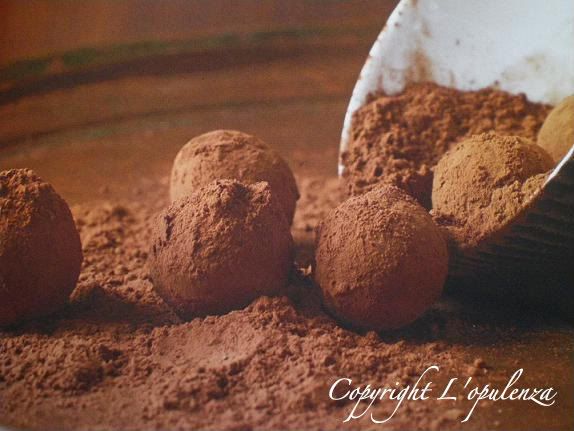
In this recipe, truffles are rolled in cocoa powder or ground nuts right after they're coated with melted chocolate. Dutch-processed cocoa powder is best for coating the truffles because it's higher in colour and less acidic than natural cocoa powder, but if you can find only natural cocoa, use it instead.


Ingredients (yields about 45)
12 ounces semisweet chocolate (55% to 60% cacao), coarsely chopped or broken into pieces
1 cup heavy cream
2 tablespoons unsalted butter, softened
1 cup cocoa powder (preferably Dutch-processed); more as needed
8 ounces semisweet chocolate, chopped
6 ounces finely chopped toasted nuts (such as almonds, hazelnuts, walnuts, pecans, peanuts and pistachios)


Method
1.  Grind the chocolate in a food processor until it reaches the consistency of coarse meal, about 30 seconds.
2.  Bring the cream to a boil in a small saucepan over medium heat. 
3.  Add the cream to the food processor and process until smooth, about 10 seconds.
4.  Add the butter to the warm (but not hot) ganache while it's still in the food processor.
5.  Process until smooth, about 10 seconds. Transfer to a medium bowl, cover tightly with plastic wrap, and refrigerate until firm, at least 2 hours or overnight.
6.  Put the cocoa powder in a large bowl. Using 2 teaspoons, shape rounded, heaping teaspoonfuls of truffle mixture and drop them onto a large, parchment-lined baking sheet.
7.  When all of the truffles are scooped, dip them in the cocoa and use your palms to roll the truffles into smooth 1-inch balls (don't worry about making them perfect; slightly irregular truffles have an appealing homemade appearance). 


8.  Transfer the truffles to the refrigerator.
9.  Melt the chocolate in a medum heatproof bowl set in a small skillet of barely simmering water, stirring occasionaly until smooth.
10. Transfer the bowl to a work surface. 
11. Working in batches, use your fingers or a couple of forks to coat the truffles with the melted chocolate.
12. Coat the truffles again with the remaining cocoa or chopped nuts (if using), and return them to the baking sheet. 
13. If using your hands, you'll have to stop and wash off the chocolate in between batches.
14. Let the truffles sit at room temperature for at least 15 minutes before serving.

MAKE AHEAD Truffles will keep for up to five days in an airtight container in the refrigerator. Bring them to room temperature before serving.

Luxuriate your senses with this simple indulgence!



Read More... Simple Chocolate Truffles

Tips and Tricks when cooking Chocolate


Melting the chocolate
Whichever method you use- in a bain-marie, a microwave or in a bowl over a saucepan of simmering water - chocolate should never be overheated when melting. Remember that the melting point of cocoa butter is approximately 30 degree C. Overheating destroys chocolate's structure, although this may not be obvious to the naked eye. Take care and make sure that the bowl used for melting is perfectly dry.


Add the ingredients to the melted chocolate
Always begin by adding the butter or cream, followed by the egg yolks, if required in the recipe. Remember that chocolate is an emulsion and is therefore very sensitive to water (even if this comes from the egg yolks) , which may cause it to seize or turn into an unworkable solid ball.

Making a ganache
The more chocolate is grated, broken up or chopped, the quicker it will dissolve, with less risk of lumps. The principle is simple, try to stick to it.

Incorporate beaten egg whites in a mousse
Always minimize the mixing time: the more you stir while incorporating the egg whites, the quicker they will lose their micro-bubbles of air.

Allow a chocolate cake to cool
Unmould it and leave to cool on baking rack so that the escaping steam can dissipate without softening the cake.

Using bitter cocoa powder
Always take the time to sift it through a fine-mesh sieve as it tends to settle and go lumpy during storage.

Useful tips: Bitter cocoa powder and all dark chocolates contain theobromine (a bitter alkaloid of the cacao plant) to which some people may be sensitive. To benefit from its positive effects, spread your consumption throughout the day!


Read More... Tips and Tricks when cooking Chocolate

Chocolate Tasting using your 5 Senses


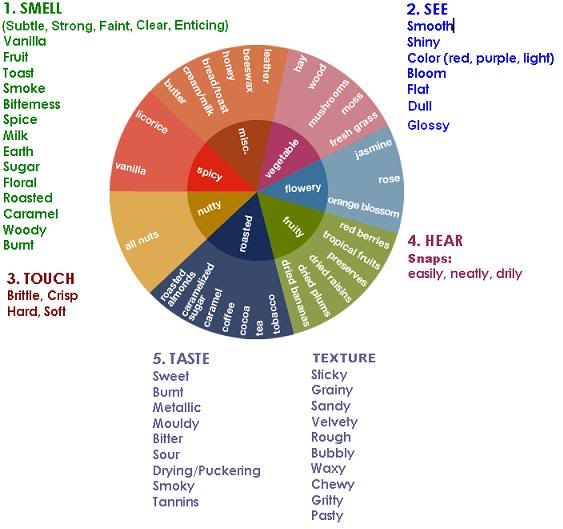
Taste is not the only guideline to sampling chocolate. Here are some explanations on how to involve all 5 senses.

Sight
Begin by evaluating the colour of the product : Is it dark brown, black, white, in between? The darker it is, the richer in cocoa. Then assess the density of the colours: one is dark brown, the other is lighter?
Next, observe the gloss, which signals that the cocoa mass has been well-tempered, moulded and cooled. Is the chocolate dull? The cocoa butter may have crystallized badly while cooling. So be careful!

Smell
The aroma of a chocolate conveys something about its life. Is it strong or weak? It is a good indicator of the percentage of cocoa and the quality of the roast. Is it sweet, musky, spicy or neutral? Single origin chocolate have a pronounced smokiness that lesser quality chocolate does not have. Can you detect a slightly unpleasant note? In such cases, the chocolate may have aged badly or has dried out.

Taste
As far as this is concerned, it is important to concentrate on the degree of sweetness. Is it balanced or too strong? Is there an acid taste? Is it perceptible? If yes, to what degree? Too much acidity indicate badly fermented or badly dried cocoa beans. Is there a slight or pronounced bitterness? These are indicators of the percentage of cocoa and the degree of roasting.

Touch
Chocolates are also sampled with the fingers. Is it smooth or slightly rough? Does it begin to melt as soon as you touch it? Does it seem smooth and silky? This will help you to judge the cocoa butter content of a chocolate and the finess of the micro-grains of  cocoa it contains.

Hearing
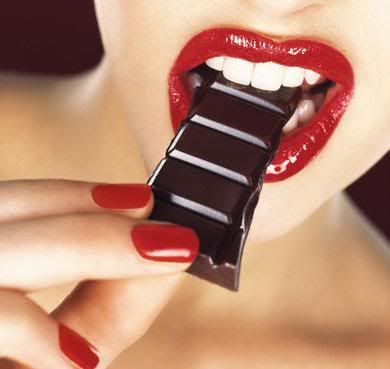
When you break a block or squares, do you hear a dry, brief snap? Or does it yield gradually and silently? In the first case, chocolate is too cold to be sampled under optimum conditions and in the second, it is probably too warm.

You can conduct an exercise by taking two bars : one dark chocolate containing 70% cocoa and one of white chocolate. Smell and touch them, nothing their differences and then break them.
Repeat it with two chocolates that are dissimilar and note their differences!

Next, we will talk about the tips and tricks when cooking chocolate..


Read More... Chocolate Tasting using your 5 Senses

Appreciating and Choosing Chocolate


Which chocolate to choose must always depend on your purpose: fine desserts or truffles, ganaches and sauces, hot chocolate, decorative molding, or artistic chocolate shape. It is also a matter of personal preference.

Your first step must be learning to read labels. Chocolate makers are increasingly aware that people want to know what is in their chocolate. Not all labels are ideally informative, but several companies are starting to provide data on some crucial matters. The most important facts, beside the origin of the beans, are total cacao content and cacao butter content.

Cacao content is what makes chocolate tastes like chocolate, no matter what its intended purpose. Standard supermarket candy bars typically have extremely low cacao content and are beefed up with fillers and sugars. Good eating bittersweet chocolates have at least the basic 35 percent cacao content. Premium chocolates (for both eating and cooking) will usually have much more, from 41 percent for a first-class milk chocolate to 70-75 percent for an intensely dark chocolate.

The only way to familiarize yourself with the range of possibilities is to buy and taste different chocolates, taking into account the amount of cacao listed. You will soon recognise the different intensities.
It would be easy to think that the best chocolate is the one with the highest cacao content, but it is not that simple. You must take into account factors such as the original beans and the handling they have received.
For example, if you are making hot chocolate, the richest product available may yield a disappointing result with an unsightly film of melted fat on top. This is the result of extra cacao butter added to some premium chocolate to decrease viscosity. The same too-rich chocolate may be perfect for coating truffles, where smoothness and fluidity are everything. A not so-smooth chocolate with great flavour and no added cacao butter might be great for hot chocolate.

A wonderful way to hone your tasting skills is to have a large sampling platter with at least a dozen chocolates made by different manufacturers and representing a wide gamut of flavours, textures and cacao contents. It will be your ultimate education in the subtleties of chocolate with company.


Read More... Appreciating and Choosing Chocolate
previous home
Related Posts with Thumbnails